Wakeboarding for Kids in Thailand (2026): Why It's One of the Best Sports Your Child Can Start Here
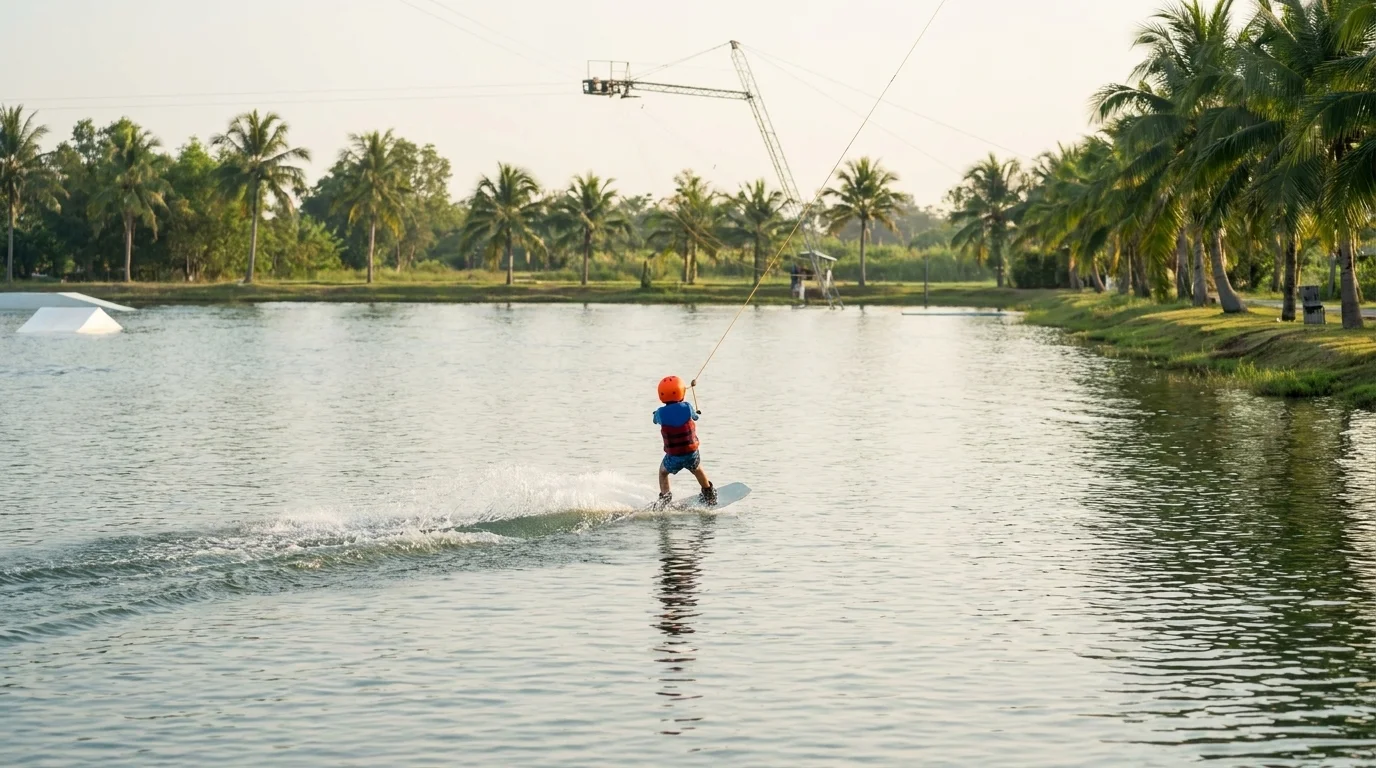
Thailand has 14 cable wake parks, warm water 12 months a year, and junior pricing under 500 baht an hour. We break down why wakeboarding is one of the highest-leverage sports a kid can pick up here - the real safety picture, the age you can start, the parks that actually cater to kids, and what the sport builds that most others don't.
Most parents looking at sports for a child in Thailand cycle through the same shortlist - swim school, gymnastics, muay thai, football. Wakeboarding rarely makes the list, partly because it sounds expensive, partly because it sounds dangerous. Both assumptions are wrong, and the real answer is that Thailand may genuinely be the single best country on earth to start a kid in this sport.
Here's the case, with the numbers.
Why Thailand specifically
The country runs 14 operational cable wake parks, with 8 of them inside a 90-minute radius of Bangkok. Water temperature stays in the high 20s to low 30s Celsius year-round, so there is no cold-water barrier that puts kids off. Compare that to Australia, the US or Europe, where cable parks are seasonal and a beginner's first 6-8 sessions get spread over a single summer. In Thailand a kid can ride every weekend for a year and stack 50+ hours on the cable before the next school year begins.
Cable systems also remove the single biggest objection most parents have to wakeboarding: there is no boat. The pull comes from an overhead cable running on a fixed circuit, the speed is controlled by the operator, and the rider stays in a designated lane the whole time. Statistically a cable park sits closer to a swimming pool than to open-water boat sports.
What age can a kid actually start
The honest answer is "earlier than you think, but not as early as you might hope." Most full-size cable parks set the floor at age 6-8 because the rider needs to physically hold the handle and maintain a basic squat under load. Below that age, the standard route is a baby-cable system (sometimes called System 2.0 or two-tower park) - shorter circuit, slower speed, lower load. Some operators take kids from age 4 on the baby cable.
The one rule that holds across every park: the child must be a confident swimmer. Wearing a vest is mandatory but not a substitute for water comfort - if a kid panics when they fall and submerge for a second, the day will go badly regardless of equipment. A few months of swim school first is the standard pre-requisite.
What the sport actually builds
The reason this matters more than "it's a fun thing they can do" is what wakeboarding compounds against time:
- Balance and proprioception: wakeboarding is a continuous balance task on an unstable surface that is also moving. Few land sports load that pattern.
- Core strength: holding the line tension at speed is essentially an isometric core hold for 5-15 seconds at a time, repeated for the whole session.
- Falling well: kids fall hundreds of times. They learn that falling is not a failure event, just a reset. That single mental shift makes future sport learning - and frankly future risk-taking in general - much easier.
- Focus under fatigue: by hour two of a session most adults are tired. Kids who push through to a clean lap at the end of a session learn what concentrated effort feels like, in a way they can clearly see results from.
- Off-screen attention span: a session at the cable is 1-3 hours of zero-screen, zero-distraction time. Most parents notice the difference within the first month.
The safety reality
The big risk profile of wakeboarding for kids is bruises, not injuries. Helmets are mandatory at every Thailand cable park - no helmet, no ride. Life vests are mandatory and included in the entry price. Cable speed is set by the operator and at beginner parks like WakeGarden and the baby cables at TWP, the line moves slow enough that a fall is essentially a slide-into-water, not an impact event.
The one part parents should pay attention to: ear protection. A handful of kids who ride frequently in fresh-water cable parks pick up swimmer's ear (otitis externa) over time. The fix is cheap (silicone ear plugs, dry ears properly after each session), but worth knowing on day one.
Which Thailand parks actually cater to kids
Not every park is set up for juniors. The ones that are, in order of how kid-friendly they actually are:
- TWP Lumlukka - Bangkok. Beginner-focused full cable plus a separate slow lane. The most common starter park for kids in the Bangkok area.
- ESC (East Side Cable) - east of Bangkok. Two-cable setup; the smaller cable is gentle, restaurant on site, often busy with families on weekends.
- WakeGarden - newer Bangkok 2-tower park, deliberately built around progression. Very approachable lap time, owner-coached.
- Phuket Wake Park - holiday-island option, good for trip-planning families. Big lake, good restaurant.
- Taco Lake - park-tier facilities, good for older kids progressing past beginner.
- Varapa Wake Park - calm rural setting, accessible from Bangkok by car.
If you are coming in from outside Thailand, the same case is even stronger: comparing wakeboarding here to Bali (2 parks) or to most home countries, the density and pricing of the Thai network is a category difference, not a degree difference.
What lessons cost and how to set up the first session
Private coaching at most Thai cable parks runs 800-1500 THB an hour. Several certified instructors work across the Bangkok parks. For a first session, plan for: a 1-hour intro with a coach, half-day pass for the kid, helmet+vest from the park, board+bindings rental from the park (around 200-300 THB), and a packed lunch because the on-site restaurants are usually adult-tier pricing.
Most kids will not stand up on their first session. That is normal and the coaches expect it. The win for session one is usually getting comfortable in the water with the board, holding a body-drag for 20-30 metres, and developing the muscle memory for handle position. Standing usually arrives in session 2-3.
Compared to swim school, muay thai, gymnastics
The math, roughly:
- Swim school - 3-5,000 THB/month, 1-2x per week. Excellent base, but plateaus once a child swims well.
- Muay thai - 200-500 THB/session, contact sport, develops different attributes (impact tolerance, conditioning) but parents are often uncomfortable with sparring at young ages.
- Gymnastics - rare and expensive in Thailand outside major cities; 1,500-3,000 THB/class.
- Wakeboarding - 250-450 THB/hour for entry, +800-1500 THB if you book a coach. Works out roughly the same as swim school once you skip the coach, and comes with a much wider skill transfer.
None of these are wrong choices. The point is that wakeboarding belongs on the shortlist - and in Thailand specifically, the cost gap that exists in most countries (where cable parks are rare and expensive) just doesn't exist.
Bottom line
If you have a confident-swimmer kid aged 6 or up, a Thailand cable park is one of the highest-leverage one-day-a-month decisions a parent here can make. The water is warm, the cable is controlled, the gear is mandatory and included, the price is fair, and the skill transfer is genuinely broad. Pick a park near you, book a one-hour intro lesson with a certified coach, bring a packed lunch, and let the kid fall a hundred times.
That last part is the part that compounds.